
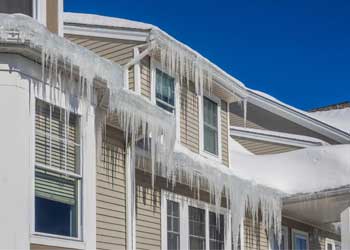
Ice Dams in New Hampshire: Why Heated Roof Systems Are the Only Permanent Fix
By late January, every New Hampshire homeowner knows the sound. A slow drip inside the ceiling near an exterior wall. Water stains blooming on drywall that was pristine in October. Icicles the size of baseball bats hanging off the eaves. Ice dams.
Every winter, we get calls from homeowners in Concord, Tilton, Meredith, Laconia, and up through the Lakes Region asking the same question: “What can I do to make sure this does not happen again next year?”
The honest answer is that most of the fixes homeowners try — roof rakes, calcium chloride socks, adding a bit more attic insulation — are partial solutions. They treat the symptom or reduce the odds, but they do not eliminate the problem. If you want to stop worrying about ice dams for the life of your roof, there is really one solution that works permanently: a professionally installed heated roof system.
Here is what that actually means, how it works, and why it is the smartest cold-weather investment a New Hampshire homeowner can make.
What Actually Causes an Ice Dam?
Ice dams are not a snow problem — they are a heat problem.
Here is the physics in plain English. Snow lands on your roof. Heat escaping from your attic warms the roof deck. The snow directly above that warm deck melts and runs down the roof slope. When the meltwater reaches the eaves — which extend past the heated part of your house and stay at outdoor temperature — it refreezes. That ridge of ice at the edge is the dam.
Then it snows again. The next round of meltwater hits the dam, has nowhere to go, and starts pooling behind it. Trapped water works its way under shingles, into flashing joints, and eventually into your ceiling.
The kicker: an ice dam can form even when it is well below freezing outside. All it needs is a warm roof deck under a snow load.
Why New Hampshire Homes Are Especially Vulnerable
NH homes get hit harder than most for a few reasons:
- Snow load. Southern NH sees 50–60 psf design snow loads; the White Mountains and Lakes Region push 60–120 psf. More snow on the roof means more meltwater available to refreeze.
- Freeze-thaw cycles. Our winters are not uniformly cold. Daytime sun and mild afternoons melt snow; overnight lows refreeze it. That cycle repeats 30+ times per winter and drives ice dam formation.
- Older housing stock. Much of the housing in Merrimack and Belknap Counties predates modern insulation standards. Attics with R-19 or less bleed heat into the roof deck.
- Complex rooflines. Additions, dormers, cathedral ceilings, and Cape-style architecture create valleys and low-slope sections where dams form fastest.
Why DIY Ice Dam Fixes Fall Short
Every year we hear the same list of attempted solutions. Here is an honest read on each.
Roof Rakes
Fine for the first three to four feet of eave, if you can reach safely. But most dams form six to ten feet up the slope, past the rake’s reach, and you cannot rake a two-story house without a ladder in the ice. Rakes address the symptom (accumulated snow), not the cause (heat loss).
Calcium Chloride Socks
Toss a pantyhose leg filled with ice melt onto the dam, and it will melt a channel through it. That works for one storm. It also corrodes aluminum gutters, stains asphalt shingles, and will not touch a well-established dam. It is a bailing-water fix, not a repair.
More Attic Insulation
This one genuinely helps and should be part of any long-term plan. But it does not help with cathedral ceilings, additions with no attic space, or complex rooflines where valleys collect blown snow. And most retrofits get you from R-19 to R-38 — better, but not enough to eliminate heat loss on a windy 15°F night.
Better Attic Ventilation
Also helpful. Balanced soffit-and-ridge ventilation keeps the roof deck close to outdoor temperature. But like insulation, it is incomplete on complex roofs and does not help low-slope sections or dormers.
The pattern: every DIY fix reduces your ice dam risk. None of them eliminates it.
How a Heated Roof System Actually Works
A heated roof system — sometimes called heat cable, heat trace, or roof heating cable — is exactly what it sounds like. Insulated electrical cable is installed in a specific pattern along the eaves, valleys, and gutters where dams form. When temperatures drop into the ice dam danger zone, the cable warms just enough to keep a continuous drainage channel open through the snow and ice.
The meltwater always has a path off the roof. No pooling. No refreezing at the eaves. No dam.
Modern systems use self-regulating cable, which adjusts its heat output based on the surrounding temperature. That means it draws more power when it is 10°F and less when it is 28°F — no wasted electricity, no risk of overheating.
A properly designed system includes:
- Eave cable in a zigzag pattern across the first two to four feet of roof
- Gutter cable running the full length of each gutter
- Downspout cable dropped inside each downspout to prevent freeze-ups
- Valley cable in any roof valley where snow collects
- Snow sensor or thermostat controller so the system only runs when it is actually needed
Well-installed systems last 10 to 15 years, use less power than most homeowners expect (typically $1 to $3 per day only during active storm conditions), and require no homeowner attention once installed.
Does It Work on Metal Roofing?
Yes — and metal roofs are actually easier to work with. Because metal sheds snow more actively than asphalt, the heat cable has less work to do. We install heat cable on both standing seam and metal shingle systems using clips designed specifically for the panel type. No penetration through the roof surface, no compromise to the warranty.
If you are planning a metal roof replacement and you have had ice dam trouble in the past, this is the time to build heat cable into the project. Retrofit later is possible but always costs more than including it at install.
When Should You Install?
Before the first sustained snow. In central and northern NH, that means finishing installation by mid-October at the latest. Installers get slammed in November and December — homeowners who wait until they see the first icicle usually have to wait weeks for a crew.
The other good reason to install now: heat cable performs best on a clean, undamaged roof. If we spot flashing issues or worn shingles during installation, we can address them before winter — not after they have been leaking for a month.
Frequently Asked Questions
Will heat cable damage my roof or shingles?
No. Properly installed, self-regulating cable operates at temperatures well below anything that would harm asphalt or metal. The clips we use do not penetrate the roof surface.
Can I retrofit heat cable onto my existing gutters?
Yes, in most cases. We inspect the gutters first — if they are already sagging or corroded, we will typically recommend replacement at the same time so you get one system that works together.
What does it cost to install?
Cost depends on linear footage of eaves, valleys, and gutters covered, plus electrical work. For a typical single-family home in Concord or Tilton, expect a mid-four-figure range. We provide a written estimate before any work begins.
How much will it add to my electric bill?
Very little. Self-regulating systems only draw power when it is cold enough to freeze water at the eaves — usually 20 to 40 days of actual operation across a full NH winter, at $1 to $3 per operating day.
Is this eligible for any rebates or tax credits?
Federal energy credits generally do not cover roof heat cable, but check with NHSaves and your utility for local programs. Your tax professional should verify anything at the federal or state level.
Can I install this myself?
The cable is available at hardware stores, but installation involves rooftop work, dedicated 120V or 240V electrical circuits, and precise layout to work correctly. Poorly installed systems either do not work or draw far more power than they should. We do not recommend DIY here.
Ready to Stop Fighting Ice Dams?
If you have been dealing with ice dams for years and you are tired of the roof rake, the calcium chloride, and the drywall repairs, this is the fall to fix it for good. Call FBI Contracting at (603) 286-4414 or email us to schedule a free consultation. We serve homeowners throughout the Concord, Tilton, Meredith, Laconia, Manchester, and Lakes Region areas.
F.B.I. Contracting, LLC is a VELUX Certified Installer and full-service metal roofing, gutter, and heated roof system contractor with 22+ years serving New Hampshire.
